Black Beauty: BMW R50S
Posted: Sun 20 Sep, 2026 10:11 pm
Black Beauty: BMW R50S
LESTER MORRIS FINALLY ACHIEVES A LONG-HELD AMBITION AND CATCHES UP WITH ONE OF THE SPORTIEST AND RAREST BMWS EVER BUILT; THE R5OS.
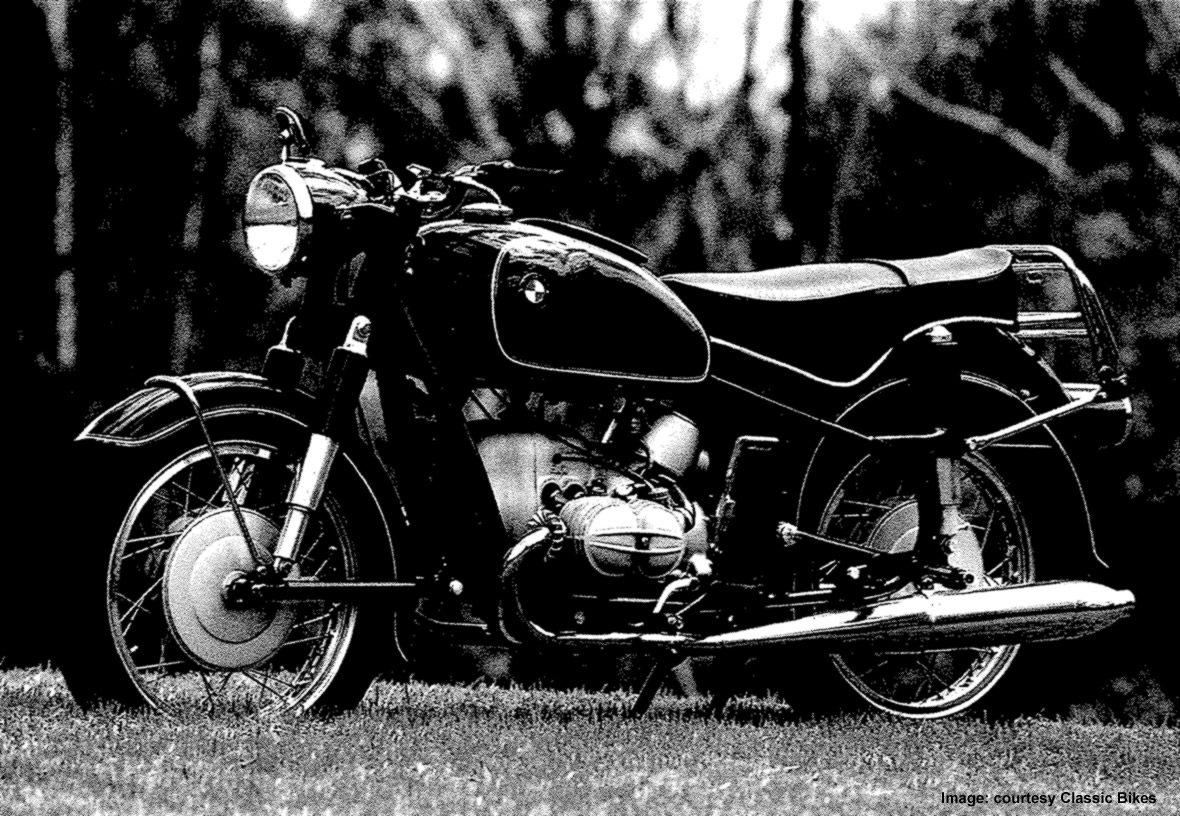
Say what you will about the Germans, they know how to produce a handsome motorcycle. Restrained black, pinstriping, alloy and chrome. Truly a Black Beauty.
One of the rarest motorcycles ever to enter this country was the sporty BMW R50S, the trim, all-black 500cc flat-twin which was built in the three years from 1960 to 1962. In all, there were just 1634 of the models made in the Munich factory, and only 14 were imported into New South Wales. There were probably no more than a couple of dozen to come into Australia during those three years and most seem quietly to have disappeared, unhappily lost in the mists of time or lying forlornly in several forgotten resting places.
Way back when the machine was brand-new, a touring friend of mine borrowed one - we never knew how rare it was - for a short ride to Junee for the National Short-Circuit Championships, and I must say I was impressed with the performance of the little rocket. At the time I was riding my potent 500cc BSA single, a machine which had been home-tuned beyond endurance with Gold Star racing cams and other goodies to provide a road performance which was the envy of many of my contemporaries. It came as no little surprise to discover that the German twin was every bit as quick on the road as my hard-ridden BSA.
All the more so, in view of the fact that the BMW's rider was on the far side of seven feet tall, and weighed more than the bike did! It looked like a small commuter machine under his enormous bulk, but its performance, and its fine handling over choppy road surfaces, was a revelation.
The R50S employed BMW's time-honoured shaft-final drive of course, its bore x stroke dimensions square at 68x68mm, with a very high - for those days - compression ratio of 9.21:1. Power output was a very respectable 26kW at a high 7650rpm. In view of the extra power of the distinctly sporty R50S, the engine employed a more substantial crankshaft assembly, the forged-steel crank cheeks at 180 degrees to one another, the shaft supported on a large ball bearing at the front and a special spherical roller bearing at the rear. A small outrigger ball bearing on the front end of the crankshaft provides additional stiffness in supporting the weight of the generator, with the camshaft supported upon a pair of similarly-sized ball bearings.
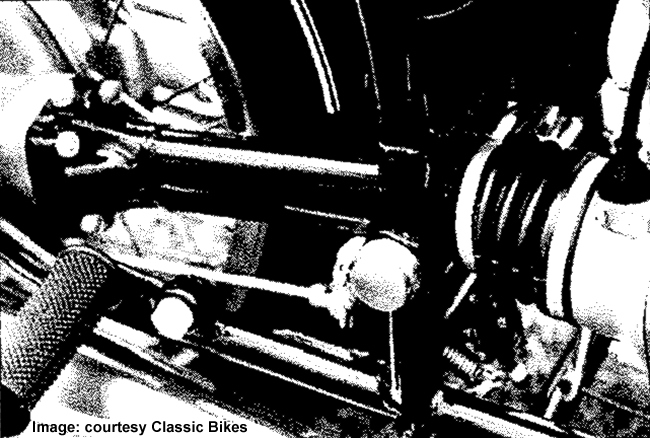
The R50S employed BMW's time-honoured shaft-final drive of course
The crank was a built-up type with caged roller big-end bearings in the same fashion as the standard R50 and the R60; the latter intended for sidecar use. As a matter of interest, the R50S could accelerate from 0-100km/h in 9. 2 seconds, more than seven seconds quicker than the 600cc model - though it must be said that the heavier flywheels fitted to the bigger machine would help account for this remarkable discrepancy.
As a further point of interest, the NSW Police force used the BMW R60 as a pursuit motorcycle in 1960, and the machine was used in quite some numbers before it was discovered that it could be blown sideways - literally! -by the brand-new Bonneville Triumphs which were the superbikes of the era.
BMW machines have always been very distinctive in appearance, even when glorying in their less-than-spectacular all-black finish, relieved by some white pinstriping and chromed panels. The model we found for this test is no exception, its showroom paintwork and highly burnished chrome and alloy castings a tribute to hard work put into its restoration by its owner, Metzeler's Australian agent, John Galvin.
I was not allowed to ride the machine which accompanied me all those years ago to Junee, although I distinctly remember pushing the thing through foot-deep snow at Blayney to get it fired-up after an enforced overnight stay, so the the opportunity at last to squirt it more-or-less in anger was too much for me to ignore. It's been said that BMW was embarrassed by the machine, which was not as smooth-running as one would expect and which was quite noisy mechanically. The exhaust note was more urgent than usual, and even less civilised when really punting hard, but this was part of the charm of the chase and perfectly acceptable to those of us who are into that sort of thing.
After all those years part of the reason for the R50S being so hard to start in the snow may have become apparent, because the larger air-filter (one of the means by which the sports model can be identified) has no choke fitted - surely an essential item when trying to start any engine in sub-zero temperatures. The air filter sits on top of the large gearbox casting, with two chromed tubes leading filtered air to a pair of 26mm Bing carburettors out in the breeze with the horizontal cylinders. The gearbox bolts to the rear of the very large casting which contains the craukshaft and to which the cast-iron cylinders are attached. The alloy cylinder heads are topped by rocker covers which have two distinctive, heavy ribs on the outer faces, which sets the sports models apart from the standard machines which have rocker covers with six much less obvious 'fins' on top.
The substantial engine casting has a wet sump which employs its own casting, with another alloy casting bolted to the front which contains the ignition and other electrical components, while a further alloy casting sits out front to round out the design and to protect the components from the weather and prying fingers of curious passers-by.
At the rear of the crankshaft assembly the flywheel and attendant single-plate clutch are bolted on, the clutch action controlled by a large diaphragm spring.
The front end of the crank is busy indeed. The crank is carried low in the casting, the camshaft on top, driven at half-engine speed by a pair of carefully mated helical gears available, even from new, in no fewer than 11 different sizes. The half-time pinion on the end of the crankshaft is steel, the much larger camshaft gear is made of aluminium alloy while a small, dished alloy gear beneath the half-time pinion drives the gear-type which oil pump which lives in the very bowels of the engine. The wet-sump oiling system is at once force-fed to the crank and big-end bearings, and thence splash fed to just about everything else by special oil slingers on the crankshaft. Pistons are, of course, aluminium alloy, with three rings, the top a specially plated compression ring, the second a chamfered ring, the lower an oil scraper.
Ignition is by magneto, driven at half-engine speed from the front of the camshaft, the magnet integral with the shaft while the stator is fixed to the alloy casting. A single set of contact points is employed with an auto-advance unit to control ignition timing.
Driven from the end of the crankshaft, the six-volt generator is rated at 60W at 1700rpm, 90 at 2100rpm, with control by voltage regulator and an 8-Amp/hour battery completing the picture. A simple light in the headlamp shell warns that ignition is switched on, and it announces that current is being generated when the engine is running by simply going out. A neat speedometer is the only other instrument fitted and it, too, sits in the top of the headlamp shell just behind the ignition switch.
If the engine is a trim design with no frills, then the shaft final-drive is a gem. The drive shaft exits the four-speed gearbox on the right side and is contained within the swinging fork which controls the rear suspension. A universal joint is attached to the front of the shaft and is supported in needle bearings, the entire unit running in an oil bath.
At the rear, the shaft is splined to accept a coupler gear which is free to slide along the splines as wheel movement occurs over bumps.
The shaft gear and large wheel pinions are both spiral bevel gears and are very precisely ground, the drive applied to the centre of the large crown wheel to overcome any possibility of the rear-end rising under heavy acceleration or dipping on the over-run. Oh, it has happened, for I can clearly remember a 1948 shaft-drive Lambretta scooter which would lift its tail at least four inches like an eager chicken whenever I tried to take off from rest. You see, directly ahead of the crown wheel-and-pinion was a small knucklejoint which allowed for a modicum of rear wheel suspension and this, coupled with an off-centre final drive was the culprit.
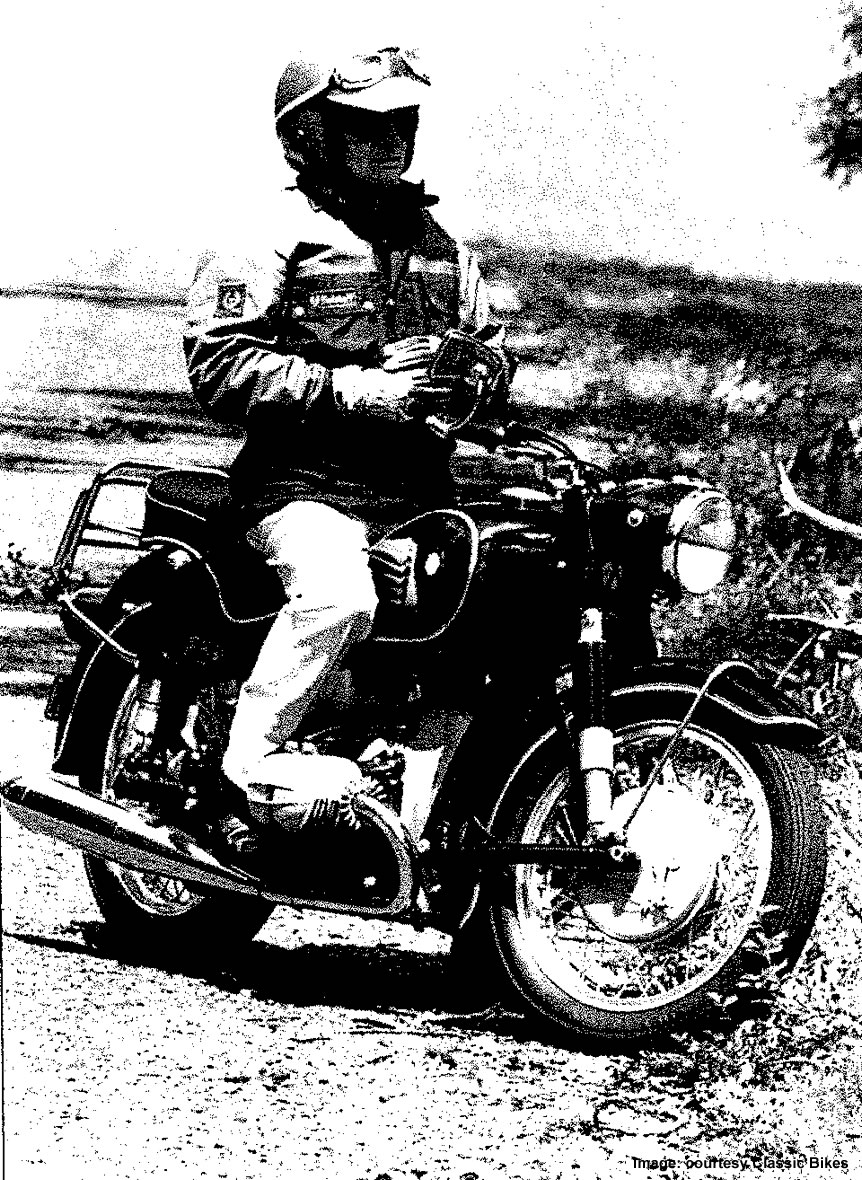
The R50S in Lester's tender care. This is a good illustration ofthe compact dimensions of the machine, and of a happy reunion with the model.
It could be said that the frames fitted to BMW machines from 1955 to 1969 were a masterpiece of design, and this could also be said of the great suspension system as well, for the German machines of that era had no peer in terms of strength, rigidity and comfort, allied to very fine handling. Oh, they had their strange design quirks, and more of that anon, but in terms of overall design and capability they were on their own.
What could you say about the BMW frame of that period, except that it was a masterpiece, in view of the manner in which it was built and the type of material employed in its construction? The frame is essentially box-section, and torsionally rigid in every plane. It is a structurally closed design, with duplex downtube and full-cradle support for the power-plant, which fits against a rubber snubber atop the alloy engine castings, and is attached to the frame by two large through-bolts under the engine.
It doesn't end there because the frame tubes are of multiple section, changing almost imperceptibly from large-diameter oval tubing at the heavily-stressed steering head to round tubular of somewhat smaller diameter for the full cradle under the engine. The twin tubes sweep back and curve upwards well behind the rear wheel suspension pivot-point to meet a single top tube under the petrol tank, changing in section from round to larger diameter oval as they go, again to allow for more strength and rigidity at high stress points.
Another tube is interpolated at the juncture of these three tubes, joining a cross-brace just under the steering head and carrying the top engine fitting with its rubber washers and mounting bolts. Two additional, vertical frame tubes are welded to the mainframe just outside the power take-off from the gearbox, and these provide attachment for the swinging-fork suspension arm. Their position also allows the swing-arm to pivot co-axially with the movement at the universal joint which helps overcome any problems of over-stressing the shaft and attendant bearings.
Far from the usual bronze bushes at the swing-arm pivot, BMW employed fully-adjustable tapered roller bearings at this high stress-point, and very large diameter ones at that. To ensure even more frame rigidity, the top mounting points for the rear shock/damper units are welded to their own braced outrigger: and thus are part of the frame. The rear shocks are two-way adjustable for load and damping.
The front suspension is by swinging arm in a similar way to normal rear suspension, and with a similarly-sized pair of shock/damper units, the pivoting-fork contained by a pair of tapered roller bearings in much the same way as at the rear and of similarly large diameter. The so-called Earles-fork was employed at the time in an on-again-off-again manner by a number of manufacturers both in England and on the Continent, but was a feature of the German twins, and 250cc singles, for 14 years. In keeping with many of the machines available in those days, the BMW frames were fitted with sidecar lugs, the pivot bearing on the front swing-arm able to be moved from its lower mounting point to one directly above to alter the trail angle for easier steering. I must say that any oaf who fitted a chair to a sports mount like this one would deserve to be prosecuted to the limit of the law.
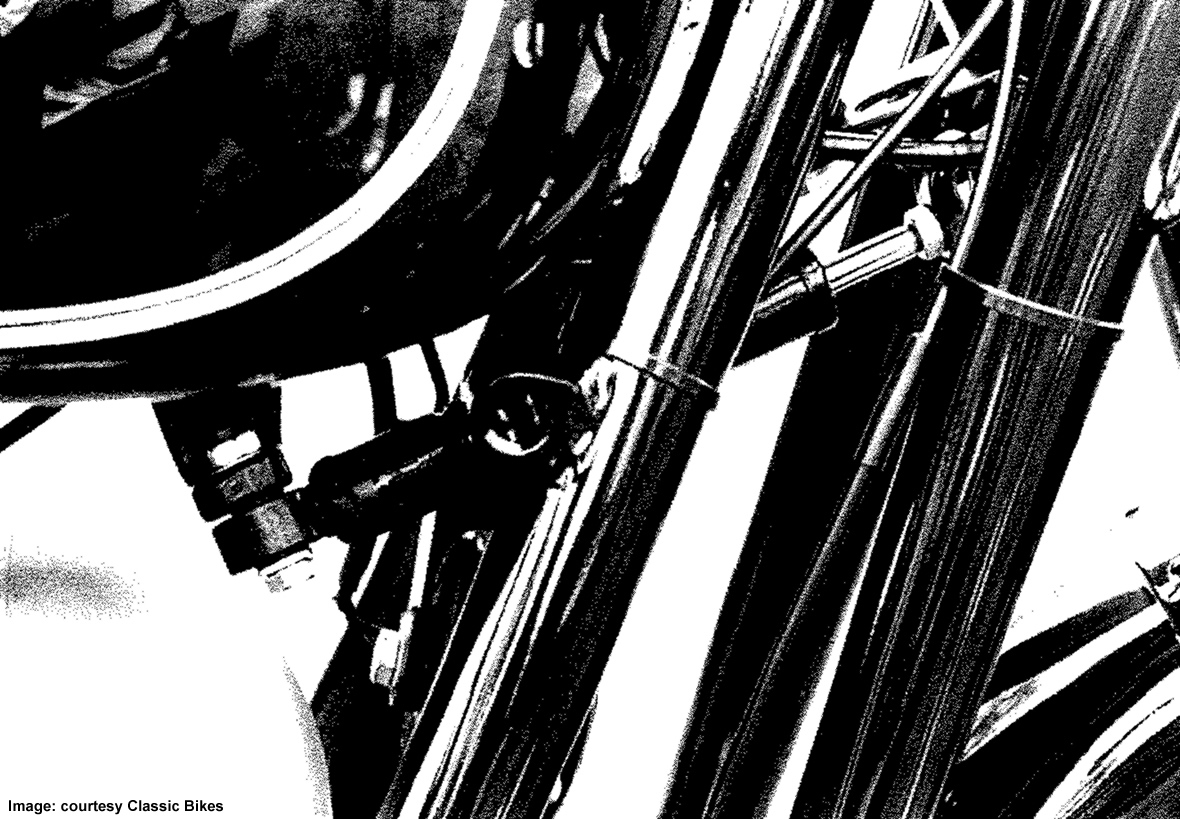
The quality of manufacture is obvious in the detail shots, as is the hydraulic steering damper nestling between the fork legs and frame tubes.
To round out the features of this great frame, the two sports models, the R50S and the 600cc R69S, employed hydraulic steering danpers, a very rare fitment indeed in those days. The damper's action is controlled by a handwheel atop the steering head, in the same manner as the friction dampers on the touring models, but of course much more efficiently.
If there is any one thing - there are two of them, actually! - which I could never come to grips with on those earlier BMW models, it was the odd kickstarter. It protruded from the engine's left side, and kicked outwards at that, which meant - at least with my short legs - that starting the device was very difficult, to say the least. The drill for those with reasonable length legs is to shove the starter pedal out with the heel of the left foot, but could never manage that at all. I had to stand on the left footrest, the machine on its centre-stand, and lean on the starter pedal with my right foot. Oh, and it was much easier if there happened to be a footpath handy, because I could then dispense with the dicey ploy of standing on the footrest, and keep all my weight off the bike as I kicked it over.
The other odd thing which beat me every time was the technique of starting the bike while facing uphill!
The problem lay with the great twin leading shoe front brake. which is of large diameter and is immensely powerful while going forward - and that is as it should be - but which simply wouldn't work at all going backwards... which happens when you are facing uphill!
You can squeeze that front brake lever as hard as you like and the bike just slips quietly away downhill and, if you are trying to kick the thing over as well, you (or at least I) get nowhere fast.
Having said that, the BMW brakes are powerful and very reliable, the front brake allied to a clever parallelogram linkage to raise the front-end under brakes and thus enjoy the benefits of a built-in, mechanical anti-dive system. The rear brake requires some thought, particularly on the change back from third to second, because there is some tendency to lock-up if braking hard, and this could be dicey if the roads happened to be wet.
The BMW wheels look very robust, to say the least, with the large brake drums laced into deep aluminium alloy rims. A feature of Earles forks is the lessening of unsprung weight, and here the lighter rims would no doubt help, though this would be negated by the deep-section valanced front guard. An even deeper rear guard helps fill in the area above the rear tyre and beneath the dual seat, heightening the impression of solidity. Tyres are 350x18 front and rear, Metzeler, of course, as they were way back when the bike was new.
Weighing in at 198kg, the R50S is not among the lightest, but is easy to heave of tha roll onto the centrestand because of the roll-on shape of the stand's legs. Oddly, internal gear ratios are the same for all four models in the range and are probably
medium/close, differing only in the final drive ratio at the rear wheel.
The R50, R60 and R69S have a final ratio of 3.13:1, the R50S, with one tooth less on the drive shaft, 3.58:1. Overall ratios for the sports 500 are well chosen if you poke it along a bit, with the top gear of 5.5:1 allowing 160km/h top speed (according to BMW) if you tuck in your elbows, ears and knees and keep your mouth shut.
As I suspected, the bike was a bit rough on the idle, though it turned over very reliably, and there was some engine noise as well with more rocking side-to-side than is usual with this type of machine; no doubt the quite high compression ratio is responsible, allied to the longitudinal torque reaction of the flat-twin engine.
Try as I may, first gear engages with a crunch you can hear three houses away, but it was ever thus and seems to be no way you can overcome it, but other gear changes on the move are quieter once you know the trick involved. You need to stroke the clutch lever and slip the left-mounted lever up for a higher gear almost before it is fully disengaged, and while engine revs, and noise, are on the way down. There is almost no way you can change back quietly, though sometimes you do and sometimes you
don't: that is an art I have simoly not yet mastered. I don't get much practice on early BMW machines, so there isn't much chance of getting it totally right!
The touring R50 runs out of puff at 5800rpm, with 19kW on hand, while the R50S peaks at 7650rpm, with an extra 7kW to call upon, an increase of nearly 40 per cent.
If ever a machine needs a tacho fitted, it is the R50S, because it is only when you squirt the thing in anger that you really appreciate the incredible difference those extra ponies make.
I've said before that memory is a fickle jade, and it could be a disappointment if one makes mental comparisons between the way things are and the way they were. I do remember the R50 as a fairly staid performer when ridden as it was intended to be ridden, even though its effortless road manners allowed the miles to be the eaten up with ease, simply because the bike was so comfortable and handled choppy surfaces so well. Not so the R50S which is a true sports mount and has to be treated that way. I speak in terms of the engine's performance, of course, not the machine's handling.
It likes to be ridden much harder than its touring brother and in fact doesn't really show its best unless pushed along, with gear changes made much later. In so doing, you can cleverly make use of the flywheel effect of faster gear changes, the energy stored in the 'wheels allowing a real surge into the next gear instead of waiting for it all to happen again.
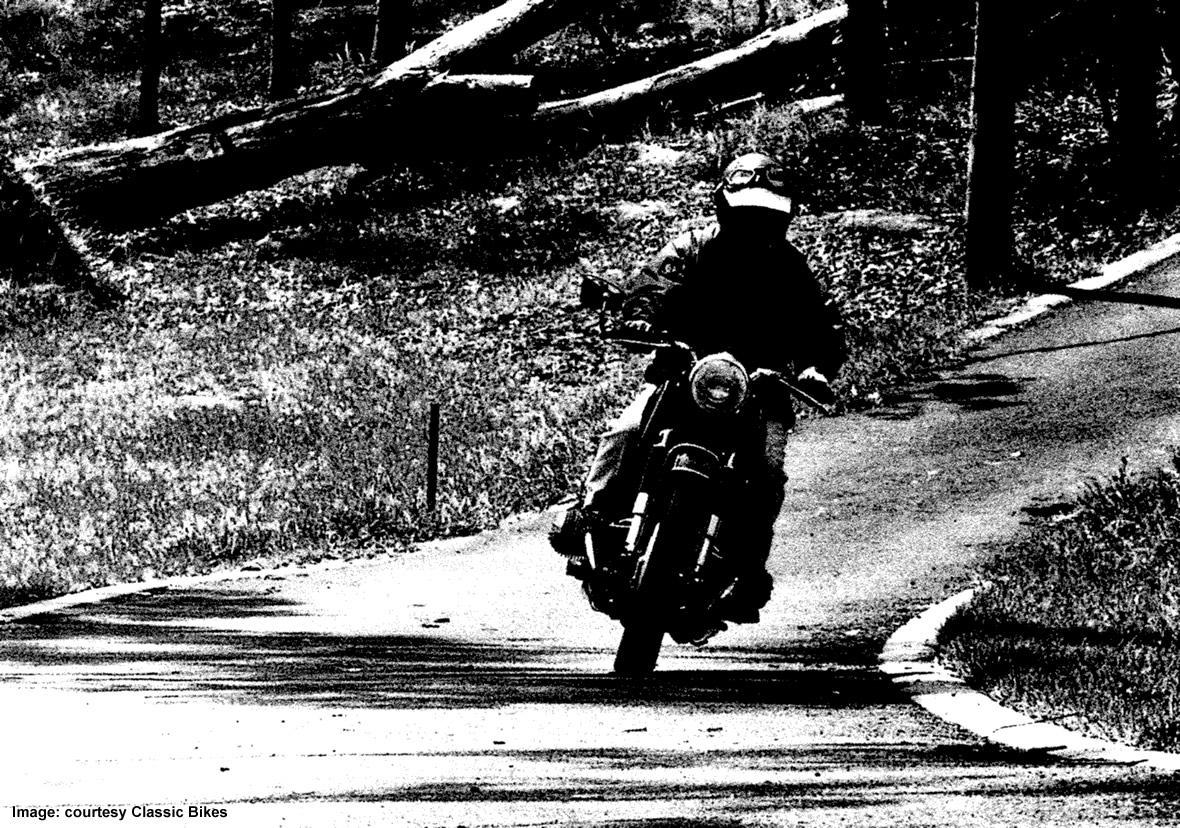
This time our man actually had a chance ride the R50S, after 30 years of wondering what it would be like. And we're happy to report that he found the experience very much to his liking...
Because of the weight of the flywheels and the engine-speed clutch, you have to get out of first gear fairly early or the crunch into second would have the Police after you, but from then on, at quite respectable speeds, you can let the engine's power work for you as you wind the thing up through the gears. Third gear is great for most overtaking moves this side of the legal limit, though top gear can be used most of the time unless
in heavy traffic or attacking steep climbs.
Acceleration is quite brisk if you keep the wick turned up, and it's probable - we never had the opportunity, unhappily - that the bike could hold its own over give-and-take surfaces with some of the more modern touring irons. It may not be quite as quick, but in terms of many of the other things that matter at least as much, it is still more than equal to the task.
The only real problem with the Earles front forks, because of their pivot point well behind the steering head, is a tendency for the front wheel to follow slighly raised road irregularities - thankfully tramlines are no longer the bugbear they once were! - and the R50S showed this slight inclination just like all those which went before. It is hardly a dangerous trait, but it can be a bit unsettling and I found I had to become used to this all over again. It just requires some thought and the occasional glance ahead at what is coming up, and the drama is lessened. You should do that, anyway, if your priority is longevity on two wheels, so perhaps the criticism is ill-founded.
However, it is a trait of the BMW front suspension, and was again in evidence. The long BMW dual seat, with its combination of long, soft springs and rubber cushioning remains one of the best ever and it nicely augments the supple suspension for which the machine has long been renowned. The handlebars are on the short side and quite flat, which I found suited me well, and which enhanced the sports image of the bike. Whether or not the machine needed the hydraulic steering damper I can't be sure, but I nipped it up over rough going at speed (it needs just a quick flick of the wrist) and eased off again in light traffic.
The damper is apparently effective, but you can't ride at slow speeds with it applied because it isn't nearly as easy to saw the handlebars back and forth.
In many ways the R50S opened up some forgotten vistas in comfort and in handling, the bike pinning itself down well through some quite choppy corners and allowing itself to be flung about from one footrest to the other with just a little abandon: it is a rare machine after all!
You could cry out for things the way they used to be, for I contend that BMW made a giant leap backwards when the Series Five machines appeared in 1969 with their cheaper frame with its bolt-on rear sub-frame to support the seat and rear suspension, and its more 'modern' engine design, but that is merely tossing chaff to the winds.
You could cry out for an electric starter on the R50S, perhaps for an overhead camshaft engine instead of a pushrod operated ohv one... But then you could cry out for a lot of things.
..which is more than he could say for the kickstarter which operates in a manner peculiar to BMW - and to Lester.
The facts are that BMW was on its last legs when the 1960 models were made, the factory almost broke and only just surviving a take-over bid by the timely intervention of a friendly bank which took an all-time punt with an injection of funds and emerged victorious.
History has recorded that the R50S and its stablemates were made to a standard and not to a price even then, and the facts are there to be seen by any who wish to judge the machine against its contemporaries. Rare though BMW machines were in those days, they survived the quicksands which swallowed up most of the motorcycle factories at the time - including virtually all the British ones - and set the factory on its way to becoming,today, one of the giants in the European car industry. The fact the BMW still manufactures motorcycles, and first-class examples at that simply ices the cake for us all.
Hey, I waited more than 30 years to ride an R50S after accompanying one of the few on a road blast all those years ago, and it was great. It's not a new model, and it has its odd quirks, but then haven't we all? The bike is a product of its times and must fairly be judged that way. The machines were quite expensive in their day, and this coincided with the near-death of the entire industry at that time. The fact that so few of them came into this country should verify that fact. The secondhand market was fairly healthy at the time with used Police R60s, so the opportunity was there to
the ride many of the German flat-twins, and we've already noted the presence of the new Bonneville Triumphs, among a few others, which helped the industry struggle on even as the Japanese began to make their presence felt.
I enjoyed my brief squirt on the R50S, not only for its own sake, but because it stirred the old memory banks as few of the classic machines have managed to do.
Do you wonder, as I do, if this is the very machine which gave me such a hard time all those years ago?
Reproduced from the pages of Classic Motorcycles
LESTER MORRIS FINALLY ACHIEVES A LONG-HELD AMBITION AND CATCHES UP WITH ONE OF THE SPORTIEST AND RAREST BMWS EVER BUILT; THE R5OS.

Say what you will about the Germans, they know how to produce a handsome motorcycle. Restrained black, pinstriping, alloy and chrome. Truly a Black Beauty.
One of the rarest motorcycles ever to enter this country was the sporty BMW R50S, the trim, all-black 500cc flat-twin which was built in the three years from 1960 to 1962. In all, there were just 1634 of the models made in the Munich factory, and only 14 were imported into New South Wales. There were probably no more than a couple of dozen to come into Australia during those three years and most seem quietly to have disappeared, unhappily lost in the mists of time or lying forlornly in several forgotten resting places.
Way back when the machine was brand-new, a touring friend of mine borrowed one - we never knew how rare it was - for a short ride to Junee for the National Short-Circuit Championships, and I must say I was impressed with the performance of the little rocket. At the time I was riding my potent 500cc BSA single, a machine which had been home-tuned beyond endurance with Gold Star racing cams and other goodies to provide a road performance which was the envy of many of my contemporaries. It came as no little surprise to discover that the German twin was every bit as quick on the road as my hard-ridden BSA.
All the more so, in view of the fact that the BMW's rider was on the far side of seven feet tall, and weighed more than the bike did! It looked like a small commuter machine under his enormous bulk, but its performance, and its fine handling over choppy road surfaces, was a revelation.
The R50S employed BMW's time-honoured shaft-final drive of course, its bore x stroke dimensions square at 68x68mm, with a very high - for those days - compression ratio of 9.21:1. Power output was a very respectable 26kW at a high 7650rpm. In view of the extra power of the distinctly sporty R50S, the engine employed a more substantial crankshaft assembly, the forged-steel crank cheeks at 180 degrees to one another, the shaft supported on a large ball bearing at the front and a special spherical roller bearing at the rear. A small outrigger ball bearing on the front end of the crankshaft provides additional stiffness in supporting the weight of the generator, with the camshaft supported upon a pair of similarly-sized ball bearings.

The R50S employed BMW's time-honoured shaft-final drive of course
The crank was a built-up type with caged roller big-end bearings in the same fashion as the standard R50 and the R60; the latter intended for sidecar use. As a matter of interest, the R50S could accelerate from 0-100km/h in 9. 2 seconds, more than seven seconds quicker than the 600cc model - though it must be said that the heavier flywheels fitted to the bigger machine would help account for this remarkable discrepancy.
As a further point of interest, the NSW Police force used the BMW R60 as a pursuit motorcycle in 1960, and the machine was used in quite some numbers before it was discovered that it could be blown sideways - literally! -by the brand-new Bonneville Triumphs which were the superbikes of the era.
BMW machines have always been very distinctive in appearance, even when glorying in their less-than-spectacular all-black finish, relieved by some white pinstriping and chromed panels. The model we found for this test is no exception, its showroom paintwork and highly burnished chrome and alloy castings a tribute to hard work put into its restoration by its owner, Metzeler's Australian agent, John Galvin.
I was not allowed to ride the machine which accompanied me all those years ago to Junee, although I distinctly remember pushing the thing through foot-deep snow at Blayney to get it fired-up after an enforced overnight stay, so the the opportunity at last to squirt it more-or-less in anger was too much for me to ignore. It's been said that BMW was embarrassed by the machine, which was not as smooth-running as one would expect and which was quite noisy mechanically. The exhaust note was more urgent than usual, and even less civilised when really punting hard, but this was part of the charm of the chase and perfectly acceptable to those of us who are into that sort of thing.
After all those years part of the reason for the R50S being so hard to start in the snow may have become apparent, because the larger air-filter (one of the means by which the sports model can be identified) has no choke fitted - surely an essential item when trying to start any engine in sub-zero temperatures. The air filter sits on top of the large gearbox casting, with two chromed tubes leading filtered air to a pair of 26mm Bing carburettors out in the breeze with the horizontal cylinders. The gearbox bolts to the rear of the very large casting which contains the craukshaft and to which the cast-iron cylinders are attached. The alloy cylinder heads are topped by rocker covers which have two distinctive, heavy ribs on the outer faces, which sets the sports models apart from the standard machines which have rocker covers with six much less obvious 'fins' on top.
The substantial engine casting has a wet sump which employs its own casting, with another alloy casting bolted to the front which contains the ignition and other electrical components, while a further alloy casting sits out front to round out the design and to protect the components from the weather and prying fingers of curious passers-by.
At the rear of the crankshaft assembly the flywheel and attendant single-plate clutch are bolted on, the clutch action controlled by a large diaphragm spring.
The front end of the crank is busy indeed. The crank is carried low in the casting, the camshaft on top, driven at half-engine speed by a pair of carefully mated helical gears available, even from new, in no fewer than 11 different sizes. The half-time pinion on the end of the crankshaft is steel, the much larger camshaft gear is made of aluminium alloy while a small, dished alloy gear beneath the half-time pinion drives the gear-type which oil pump which lives in the very bowels of the engine. The wet-sump oiling system is at once force-fed to the crank and big-end bearings, and thence splash fed to just about everything else by special oil slingers on the crankshaft. Pistons are, of course, aluminium alloy, with three rings, the top a specially plated compression ring, the second a chamfered ring, the lower an oil scraper.
Ignition is by magneto, driven at half-engine speed from the front of the camshaft, the magnet integral with the shaft while the stator is fixed to the alloy casting. A single set of contact points is employed with an auto-advance unit to control ignition timing.
Driven from the end of the crankshaft, the six-volt generator is rated at 60W at 1700rpm, 90 at 2100rpm, with control by voltage regulator and an 8-Amp/hour battery completing the picture. A simple light in the headlamp shell warns that ignition is switched on, and it announces that current is being generated when the engine is running by simply going out. A neat speedometer is the only other instrument fitted and it, too, sits in the top of the headlamp shell just behind the ignition switch.
If the engine is a trim design with no frills, then the shaft final-drive is a gem. The drive shaft exits the four-speed gearbox on the right side and is contained within the swinging fork which controls the rear suspension. A universal joint is attached to the front of the shaft and is supported in needle bearings, the entire unit running in an oil bath.
At the rear, the shaft is splined to accept a coupler gear which is free to slide along the splines as wheel movement occurs over bumps.
The shaft gear and large wheel pinions are both spiral bevel gears and are very precisely ground, the drive applied to the centre of the large crown wheel to overcome any possibility of the rear-end rising under heavy acceleration or dipping on the over-run. Oh, it has happened, for I can clearly remember a 1948 shaft-drive Lambretta scooter which would lift its tail at least four inches like an eager chicken whenever I tried to take off from rest. You see, directly ahead of the crown wheel-and-pinion was a small knucklejoint which allowed for a modicum of rear wheel suspension and this, coupled with an off-centre final drive was the culprit.

The R50S in Lester's tender care. This is a good illustration ofthe compact dimensions of the machine, and of a happy reunion with the model.
It could be said that the frames fitted to BMW machines from 1955 to 1969 were a masterpiece of design, and this could also be said of the great suspension system as well, for the German machines of that era had no peer in terms of strength, rigidity and comfort, allied to very fine handling. Oh, they had their strange design quirks, and more of that anon, but in terms of overall design and capability they were on their own.
What could you say about the BMW frame of that period, except that it was a masterpiece, in view of the manner in which it was built and the type of material employed in its construction? The frame is essentially box-section, and torsionally rigid in every plane. It is a structurally closed design, with duplex downtube and full-cradle support for the power-plant, which fits against a rubber snubber atop the alloy engine castings, and is attached to the frame by two large through-bolts under the engine.
It doesn't end there because the frame tubes are of multiple section, changing almost imperceptibly from large-diameter oval tubing at the heavily-stressed steering head to round tubular of somewhat smaller diameter for the full cradle under the engine. The twin tubes sweep back and curve upwards well behind the rear wheel suspension pivot-point to meet a single top tube under the petrol tank, changing in section from round to larger diameter oval as they go, again to allow for more strength and rigidity at high stress points.
Another tube is interpolated at the juncture of these three tubes, joining a cross-brace just under the steering head and carrying the top engine fitting with its rubber washers and mounting bolts. Two additional, vertical frame tubes are welded to the mainframe just outside the power take-off from the gearbox, and these provide attachment for the swinging-fork suspension arm. Their position also allows the swing-arm to pivot co-axially with the movement at the universal joint which helps overcome any problems of over-stressing the shaft and attendant bearings.
Far from the usual bronze bushes at the swing-arm pivot, BMW employed fully-adjustable tapered roller bearings at this high stress-point, and very large diameter ones at that. To ensure even more frame rigidity, the top mounting points for the rear shock/damper units are welded to their own braced outrigger: and thus are part of the frame. The rear shocks are two-way adjustable for load and damping.
The front suspension is by swinging arm in a similar way to normal rear suspension, and with a similarly-sized pair of shock/damper units, the pivoting-fork contained by a pair of tapered roller bearings in much the same way as at the rear and of similarly large diameter. The so-called Earles-fork was employed at the time in an on-again-off-again manner by a number of manufacturers both in England and on the Continent, but was a feature of the German twins, and 250cc singles, for 14 years. In keeping with many of the machines available in those days, the BMW frames were fitted with sidecar lugs, the pivot bearing on the front swing-arm able to be moved from its lower mounting point to one directly above to alter the trail angle for easier steering. I must say that any oaf who fitted a chair to a sports mount like this one would deserve to be prosecuted to the limit of the law.

The quality of manufacture is obvious in the detail shots, as is the hydraulic steering damper nestling between the fork legs and frame tubes.
To round out the features of this great frame, the two sports models, the R50S and the 600cc R69S, employed hydraulic steering danpers, a very rare fitment indeed in those days. The damper's action is controlled by a handwheel atop the steering head, in the same manner as the friction dampers on the touring models, but of course much more efficiently.
If there is any one thing - there are two of them, actually! - which I could never come to grips with on those earlier BMW models, it was the odd kickstarter. It protruded from the engine's left side, and kicked outwards at that, which meant - at least with my short legs - that starting the device was very difficult, to say the least. The drill for those with reasonable length legs is to shove the starter pedal out with the heel of the left foot, but could never manage that at all. I had to stand on the left footrest, the machine on its centre-stand, and lean on the starter pedal with my right foot. Oh, and it was much easier if there happened to be a footpath handy, because I could then dispense with the dicey ploy of standing on the footrest, and keep all my weight off the bike as I kicked it over.
The other odd thing which beat me every time was the technique of starting the bike while facing uphill!
The problem lay with the great twin leading shoe front brake. which is of large diameter and is immensely powerful while going forward - and that is as it should be - but which simply wouldn't work at all going backwards... which happens when you are facing uphill!
You can squeeze that front brake lever as hard as you like and the bike just slips quietly away downhill and, if you are trying to kick the thing over as well, you (or at least I) get nowhere fast.
Having said that, the BMW brakes are powerful and very reliable, the front brake allied to a clever parallelogram linkage to raise the front-end under brakes and thus enjoy the benefits of a built-in, mechanical anti-dive system. The rear brake requires some thought, particularly on the change back from third to second, because there is some tendency to lock-up if braking hard, and this could be dicey if the roads happened to be wet.
The BMW wheels look very robust, to say the least, with the large brake drums laced into deep aluminium alloy rims. A feature of Earles forks is the lessening of unsprung weight, and here the lighter rims would no doubt help, though this would be negated by the deep-section valanced front guard. An even deeper rear guard helps fill in the area above the rear tyre and beneath the dual seat, heightening the impression of solidity. Tyres are 350x18 front and rear, Metzeler, of course, as they were way back when the bike was new.
Weighing in at 198kg, the R50S is not among the lightest, but is easy to heave of tha roll onto the centrestand because of the roll-on shape of the stand's legs. Oddly, internal gear ratios are the same for all four models in the range and are probably
medium/close, differing only in the final drive ratio at the rear wheel.
The R50, R60 and R69S have a final ratio of 3.13:1, the R50S, with one tooth less on the drive shaft, 3.58:1. Overall ratios for the sports 500 are well chosen if you poke it along a bit, with the top gear of 5.5:1 allowing 160km/h top speed (according to BMW) if you tuck in your elbows, ears and knees and keep your mouth shut.
As I suspected, the bike was a bit rough on the idle, though it turned over very reliably, and there was some engine noise as well with more rocking side-to-side than is usual with this type of machine; no doubt the quite high compression ratio is responsible, allied to the longitudinal torque reaction of the flat-twin engine.
Try as I may, first gear engages with a crunch you can hear three houses away, but it was ever thus and seems to be no way you can overcome it, but other gear changes on the move are quieter once you know the trick involved. You need to stroke the clutch lever and slip the left-mounted lever up for a higher gear almost before it is fully disengaged, and while engine revs, and noise, are on the way down. There is almost no way you can change back quietly, though sometimes you do and sometimes you
don't: that is an art I have simoly not yet mastered. I don't get much practice on early BMW machines, so there isn't much chance of getting it totally right!
The touring R50 runs out of puff at 5800rpm, with 19kW on hand, while the R50S peaks at 7650rpm, with an extra 7kW to call upon, an increase of nearly 40 per cent.
If ever a machine needs a tacho fitted, it is the R50S, because it is only when you squirt the thing in anger that you really appreciate the incredible difference those extra ponies make.
I've said before that memory is a fickle jade, and it could be a disappointment if one makes mental comparisons between the way things are and the way they were. I do remember the R50 as a fairly staid performer when ridden as it was intended to be ridden, even though its effortless road manners allowed the miles to be the eaten up with ease, simply because the bike was so comfortable and handled choppy surfaces so well. Not so the R50S which is a true sports mount and has to be treated that way. I speak in terms of the engine's performance, of course, not the machine's handling.
It likes to be ridden much harder than its touring brother and in fact doesn't really show its best unless pushed along, with gear changes made much later. In so doing, you can cleverly make use of the flywheel effect of faster gear changes, the energy stored in the 'wheels allowing a real surge into the next gear instead of waiting for it all to happen again.

This time our man actually had a chance ride the R50S, after 30 years of wondering what it would be like. And we're happy to report that he found the experience very much to his liking...
Because of the weight of the flywheels and the engine-speed clutch, you have to get out of first gear fairly early or the crunch into second would have the Police after you, but from then on, at quite respectable speeds, you can let the engine's power work for you as you wind the thing up through the gears. Third gear is great for most overtaking moves this side of the legal limit, though top gear can be used most of the time unless
in heavy traffic or attacking steep climbs.
Acceleration is quite brisk if you keep the wick turned up, and it's probable - we never had the opportunity, unhappily - that the bike could hold its own over give-and-take surfaces with some of the more modern touring irons. It may not be quite as quick, but in terms of many of the other things that matter at least as much, it is still more than equal to the task.
The only real problem with the Earles front forks, because of their pivot point well behind the steering head, is a tendency for the front wheel to follow slighly raised road irregularities - thankfully tramlines are no longer the bugbear they once were! - and the R50S showed this slight inclination just like all those which went before. It is hardly a dangerous trait, but it can be a bit unsettling and I found I had to become used to this all over again. It just requires some thought and the occasional glance ahead at what is coming up, and the drama is lessened. You should do that, anyway, if your priority is longevity on two wheels, so perhaps the criticism is ill-founded.
However, it is a trait of the BMW front suspension, and was again in evidence. The long BMW dual seat, with its combination of long, soft springs and rubber cushioning remains one of the best ever and it nicely augments the supple suspension for which the machine has long been renowned. The handlebars are on the short side and quite flat, which I found suited me well, and which enhanced the sports image of the bike. Whether or not the machine needed the hydraulic steering damper I can't be sure, but I nipped it up over rough going at speed (it needs just a quick flick of the wrist) and eased off again in light traffic.
The damper is apparently effective, but you can't ride at slow speeds with it applied because it isn't nearly as easy to saw the handlebars back and forth.
In many ways the R50S opened up some forgotten vistas in comfort and in handling, the bike pinning itself down well through some quite choppy corners and allowing itself to be flung about from one footrest to the other with just a little abandon: it is a rare machine after all!
You could cry out for things the way they used to be, for I contend that BMW made a giant leap backwards when the Series Five machines appeared in 1969 with their cheaper frame with its bolt-on rear sub-frame to support the seat and rear suspension, and its more 'modern' engine design, but that is merely tossing chaff to the winds.
You could cry out for an electric starter on the R50S, perhaps for an overhead camshaft engine instead of a pushrod operated ohv one... But then you could cry out for a lot of things.

..which is more than he could say for the kickstarter which operates in a manner peculiar to BMW - and to Lester.
The facts are that BMW was on its last legs when the 1960 models were made, the factory almost broke and only just surviving a take-over bid by the timely intervention of a friendly bank which took an all-time punt with an injection of funds and emerged victorious.
History has recorded that the R50S and its stablemates were made to a standard and not to a price even then, and the facts are there to be seen by any who wish to judge the machine against its contemporaries. Rare though BMW machines were in those days, they survived the quicksands which swallowed up most of the motorcycle factories at the time - including virtually all the British ones - and set the factory on its way to becoming,today, one of the giants in the European car industry. The fact the BMW still manufactures motorcycles, and first-class examples at that simply ices the cake for us all.
Hey, I waited more than 30 years to ride an R50S after accompanying one of the few on a road blast all those years ago, and it was great. It's not a new model, and it has its odd quirks, but then haven't we all? The bike is a product of its times and must fairly be judged that way. The machines were quite expensive in their day, and this coincided with the near-death of the entire industry at that time. The fact that so few of them came into this country should verify that fact. The secondhand market was fairly healthy at the time with used Police R60s, so the opportunity was there to
the ride many of the German flat-twins, and we've already noted the presence of the new Bonneville Triumphs, among a few others, which helped the industry struggle on even as the Japanese began to make their presence felt.
I enjoyed my brief squirt on the R50S, not only for its own sake, but because it stirred the old memory banks as few of the classic machines have managed to do.
Do you wonder, as I do, if this is the very machine which gave me such a hard time all those years ago?
Reproduced from the pages of Classic Motorcycles